Willow Glen, San Jose: a neighborhood report
Last checked
Willow Glen was its own city for nine years, from 1927 until its voters chose to join San José in 1936. Today it’s a neighborhood southwest of downtown, roughly between the Guadalupe River and Los Gatos Creek, south of Interstate 280. Most of it is in ZIP code 95125, though the ZIP and the neighborhood don’t line up exactly.
On the map: the flood zones
Most of Willow Glen sits in FEMA flood Zone D, where flood risk is possible but hasn’t been studied. Zone D is outside the areas where federal rules require flood insurance, though a lender can still ask for it. A band along the Guadalupe River is mapped as high-risk shallow flooding, usually a foot or two deep. That’s Zone AO around Bird Avenue and Willow Street, and Zone AH near Redbird Drive.
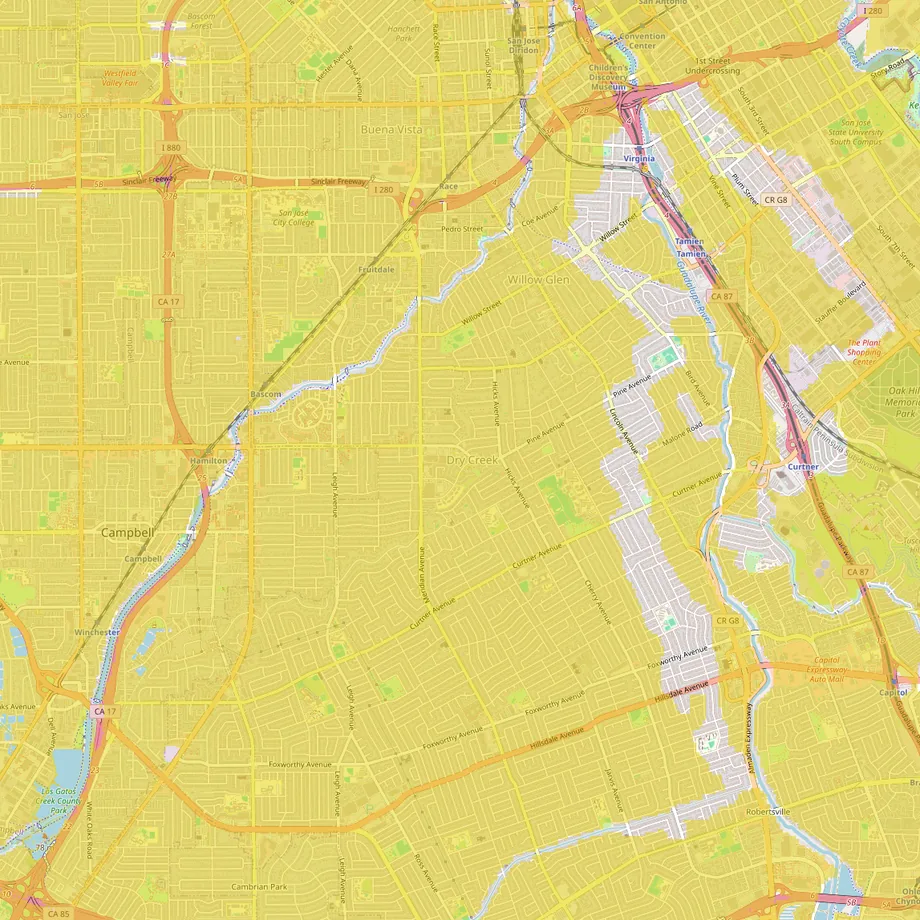
The river has flooded here before. In January 1995 the Guadalupe flooded the Gardner district. That March, a levee failure near Alma Avenue flooded Willow Street and nearby streets east of the river. Valley Water’s Upper Guadalupe project covers the 5.5 miles from Interstate 280 to Blossom Hill Road. As of 2026 its schedule runs to 2033, and federal funding has slipped before. Our guide to reading a FEMA flood map explains the zone letters.
What the ground and the houses are like
Parts of Willow Glen sit on heavy clay. The federal soil survey maps the ground at Lincoln Avenue and Willow Street as clay that swells when wet and shrinks when dry. That moves foundations, cracks slabs and sticks doors. About a quarter of the area is also in a state liquefaction zone. There the city geologist must sign off before major grading or building permits. A foundation inspection is money well spent.
Many of the houses are old. In ZIP code 95125 the median home was built in 1965, and four in ten before 1960, so have the plumbing and wiring inspected. Subterranean termites are common throughout California. A UC Davis entomologist has said homes built on old orchard land can inherit colonies, and much of Willow Glen was orchards. Get a termite inspection.
Two more owner costs surprise newcomers. In San José the homeowner pays to repair the sidewalk, park strip and curb in front of the house, often lifted by street-tree roots. And the nearest state-zoned fault is about 6.5 miles away, with the San Andreas, Calaveras and Hayward faults each about 10 miles off.
A short history
The land was part of two Mexican-era ranchos, then orchards once a canal tamed the Guadalupe in the late 1860s. By 1913 the orchards were being subdivided into homes, with Palm Haven among the first. Willow Glen incorporated in 1927, in part to keep the Southern Pacific from running trains down Lincoln Avenue. The railroad moved its line, and in 1936 voters chose to join San José, 978 to 871, for sewer connections and a high school.
Remodeling, ADUs and lot splits
Before you plan changes to a house, check whether it’s in one of these:
- Palm Haven Conservation Area, between Riverside Drive, Bird Avenue and Coe Avenue. Its homes date from about 1910 through the 1940s, and its palms are protected as heritage trees.
- North Willow Glen Conservation Area, south of 280 between the river, Willow Street and Bird Avenue, mostly small-lot homes from 1885 to 1955.
- Fairglen Additions, on the National Register since 2019: 218 Eichler homes built from 1959 to 1961 around Fairglen Drive and Booksin Avenue. The listing adds no rules by itself. The city has drafted Eichler design standards for this district; check their status with the Planning Division.
Homes in a conservation area need a city Single-Family House Permit for many exterior changes. Outside those rules, state law has opened up a lot. San José offers pre-approved backyard cottage (ADU) plans, and in 2025 became the first California city to let owners sell an ADU as a condo. Under SB 9, a single-family lot can hold up to four homes with ADUs. An owner who splits a lot must live on one part for three years. Since July 2026, SB 79 has allowed denser housing near qualifying transit stops; the city publishes a map of the parcels it covers.
What’s being built
New housing is arriving. At 940 Willow Street, a seven-story building with 126 apartments and ground-floor retail was approved in 2026. It went through the state’s “builder’s remedy” rules, which bypass local zoning, and a neighbor sued that April over sewer capacity. A lot at 1655 Lincoln Avenue was rezoned for up to five homes. Expect more projects like these as the new state laws take hold.
Lincoln Avenue and the shops
Lincoln Avenue is the main street, with more than 250 businesses. Its landmark is the Garden Theater building, a cinema until 1988 and now shops and offices under the old marquee. The old volunteer fire station at 1342 Lincoln dates from 1930. Arteaga’s market is on Lincoln, and a Safeway is under a mile away.
For bigger trips, a Target, a Home Depot and a Walmart Supercenter are each about 3 miles by road, and the nearest Costco about 3.5. Westfield Valley Fair and Santana Row are about 3.5 miles away, and Westfield Oakridge about 5.5.
What locals do for fun
Saturday mornings start at the farmers’ market at Willow Glen Elementary, 9 a.m. to 1 p.m. Glen Fest is held on Lincoln Avenue in late September, and December brings trolley rides and a holiday walk. The Los Gatos Creek, Three Creeks and Guadalupe River trails run along and through the neighborhood. A steel bridge, opened in 2021 in place of the old railroad trestle, joins the Three Creeks and Los Gatos Creek trails. Willow Street Frank Bramhall Park has a lawn bowling club, tennis and pickleball.
Big events are close. SAP Center, home of the Sharks, is about 2 miles away, and so is the San José State football stadium. Levi’s Stadium is about 10 miles, and the Santa Cruz Boardwalk about 45 minutes by car.
Getting around
Interstate 280 runs along the north edge, and Highway 87 and a rail line along the east, which matters if noise does. VTA light rail stops at Tamien, Curtner and Virginia near the east side. Tamien also has Caltrain, which resumed there in January 2026, about 1.4 miles by road from the middle of the neighborhood. Diridon station is about 2 miles, and San José’s airport about 6. In its usual direction the airport brings planes in over downtown; its WebTrak tool shows tracks over any address.
Services, taxes and climate
- Electricity: San José Clean Energy supplies it by default, and PG&E delivers it and sends the bill.
- Hospitals: Santa Clara Valley Medical Center is about 2.5 miles away and O’Connor about 3.5.
- Schools: most of the area is in the San José Unified School District. Check the district’s boundary tool for an address.
- Property tax: California’s base rate is 1% of assessed value plus voter-approved local charges. Assessed value can rise at most 2% a year until the home is sold.
- Climate: about 16 inches of rain a year, almost all from fall to spring, and no snow.
Facts on this page were checked against city, county, state and federal sources on October 31, 2026.
Explore it yourself
Open the map over Willow Glen with flood zones, walkability and parks switched on, then add what matters to you.